
On my recent trip through southern Poland, I started a little experiment. I began noticing how often my mind was trying to make things better. Travelling is particularly good territory for this. There is so much to see and only so much time.
So the mind starts calculating: Could we fit in one more place? Take a slightly longer walk? Get a few thousand more steps in? Are we really making the most of our day?
Nothing wrong with any of that. I love exploring new places. But I became curious about the subtle sense of not quite enough underneath it.
The mind that wants something better
The mind that wants something better
It showed up in surprisingly mundane places.
At the hotel breakfast buffet, I noticed a little flicker of concern when the fruit salad was nearly empty. Would they refill it? Should I get some now before it disappeared? There was an abundance of food around me. And yet, for a brief moment, my attention was captured by the one thing that might not be available.
My favourite observation happened while reading. I had found a nice spot, sat down with my book and was ready to relax. Except that another part of my mind was still busy. Was this really the best place to sit? Perhaps the bench over there had more shade. Or a nicer view. Maybe somewhere else would be quieter. I had somehow managed to turn relaxing into an optimisation project.
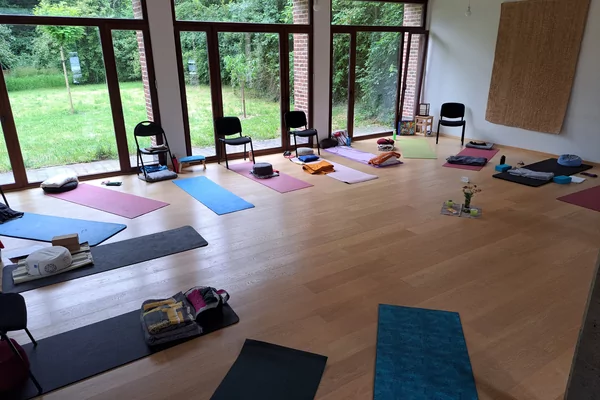
Even my morning yoga wasn't immune. I noticed myself looking for the best place to practise: somewhere more peaceful, more beautiful, with the perfect view. The irony wasn't lost on me. Non-striving is one of the seven foundational attitudes of mindfulness described by Jon Kabat-Zinn: practising without constantly trying to get somewhere else, achieve a particular state or make this moment better. And there I was, trying to find a better place to practise non-striving. Apparently, even mindfulness can be optimised.
Once I started seeing this pattern, I decided to experiment with doing the opposite. Instead of getting up and looking for the perfect reading spot, I stayed. The bench wasn't perfect. The conditions weren't perfect. And I decided to let them be exactly as they were. After a while, I noticed something change. My body settled. I became absorbed in my book.
I relaxed.
Not because I had finally found the perfect conditions, but because I had stopped trying to improve them.
The difficulty of enough
It made me wonder how much energy we spend, often without realising it, trying to get from here to slightly better. A better holiday. A more productive day. More steps. A healthier breakfast. A better place to sit. Even, apparently, a better place to practise mindfulness. There is nothing inherently wrong with striving. It helps us learn, create, build, solve problems and change things that genuinely need changing. But perhaps there is a difference between choosing to strive and not knowing how to stop striving. Because the logic of “more” doesn't only exist inside our heads. It is all around us.
Companies are expected to grow. Shareholders expect increasing returns. Economies celebrate rising consumption and productivity. Our phones count our steps, our watches measure our sleep and our apps help us optimise almost every aspect of our lives.
At the same time, we are increasingly confronted with the limits of “more” — in our own capacity, in organisations and in the natural systems we depend on. Of course, my search for the perfect reading bench and the challenges of our economic system are not the same thing. But perhaps there is a question worth asking at both levels:
How good are we at recognising when something is enough?
Contentment isn't complacency
Perhaps this is why the idea of contentment feels surprisingly relevant today. Contentment doesn't mean that we stop having aspirations. It doesn't mean accepting things that need to change, abandoning ambition or deciding that we shouldn't grow. It means being able to experience enough alongside wanting, creating and developing.
I can want tomorrow to be different without requiring this moment to be different. I can enjoy breakfast even when the fruit salad has gone. I can visit one place instead of three. I can sit on the slightly imperfect bench.
Mindfulness helps us notice that moment when healthy intention turns into restless striving: the subtle tightening, comparing and scanning for something better. And once we notice it, we have a choice.
Sometimes it makes sense to get up and find the better bench. And sometimes we might stay. So perhaps a small experiment for thenext weeks: Notice the moments when your mind says more, better, not yet, not quite. And every now and then, see what happens when you don't follow it.
When you let something be slightly imperfect.
When you stop optimising.
When you allow yourself to arrive.
You might discover, as I did on that bench in Poland, that contentment doesn't always come from finally getting what we were looking for.
Sometimes it appears when we stop looking.